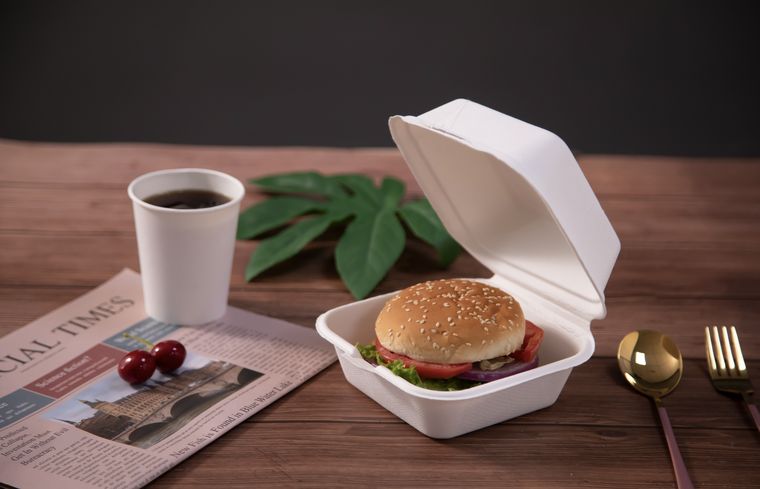
my country's modern fully automatic pulp tableware equipment industry has developed for nearly 40 years. In 1984, Hunan Fully Automatic Pulp Tableware Equipment Factory invested more than 10 million yuan to introduce a roller-type fully automatic pulp tableware equipment production line from France, mainly used for egg trays. Production, this is the beginning of China's fully automatic pulp tableware equipment. Subsequently, Beijing, Shandong, Jiangsu and other places introduced foreign fully automatic pulp tableware equipment production lines for the production of egg trays. In the late 1980s, my country began its own research on fully automatic pulp tableware equipment production lines. In 1988, my country developed a domestic fully automatic pulp tableware equipment production line, mainly focusing on egg trays, beer trays and fruit trays. The products were single and low-grade. Since the 1990s, fully automatic pulp tableware equipment products have been used for packaging agricultural and sideline products, home appliances, electronics, instruments and meters. Since 2011, my country's fully automatic pulp tableware equipment industry has developed rapidly. Since 2014, it has developed rapidly. According to the research on the fully automatic pulp tableware equipment packaging market by a world-renowned market analysis institution, Global Market Insights analyzed that the global fully automatic pulp tableware equipment packaging industry market size will be US$3.2 billion in 2020, and will maintain a growth rate of 5.1% in the next seven years. Grand View Research analyzes that the global scale of fully automatic pulp tableware equipment will be US$4 billion in 2020, and will maintain a growth rate of 6.1% in the next eight years. Verified Market Research analyzes that the global scale of fully automatic pulp tableware equipment will be US$3.8 billion in 2020 and will continue to grow in the next eight years. will maintain a growth rate of 5.3%, and ReportLinker analysis states that the scale of global fully automatic pulp tableware equipment will be US$4.3 billion in 2020, and will maintain a growth rate of 4.7% in the next seven years. 1. Product life cycle management. Production management consists of the company's existing ERP, OA, EAS, HR, DCS, PLC systems and the newly introduced production automation systems HOLLiAS, WMS, RFS, WCS systems, etc., as well as the plan execution layer and production control layer. Connection can realize the full life cycle management of products and provide timely and accurate decision-making basis. 2. Automatically schedule production plans. The production plan management system at the plan execution layer automatically formulates production plans, material demand plans, workshop operation plans and other information fed back by the production control layer based on the orders, product inventory, raw material supply and other information fed back by the production management and workshop production to realize the production process. Automatic scheduling. 3. Production line automation. Key equipment such as robots, conveyor lines, and manipulator integrated molding machines, setting machines, and trimming machines were introduced, and the HOLLiAS system was built as a supporting system to closely connect the various processes and realize the automation of the production line. Combined with the existing DCS and PLC systems, production data can be automatically collected and uploaded to the data platform in real time, allowing the planning execution layer and production management layer to grasp production progress, on-site and other production site information operations, quality inspection, and equipment status in a timely manner. 4. System integration. This project integrates various information systems and establishes a communication network in the workshop, which can realize information exchange between the production management layer, planning execution layer, and production control layer, realize systems, equipment, parts and personnel, and realize orders. , sales, product to production, procurement, inventory, finance and other integrated management. 5. Digital production and information security. Product design is carried out through computer-aided software such as CAD and CAX/PDM (mold design software) to achieve digital design and production capabilities. The company has established a database platform that covers data information at all levels and enables data interoperability between various systems. A five-in-one protection mechanism including network security protection, firewalls, intrusion detection, web page anti-tampering, and anti-virus software has been established to effectively improve the company's information security.
News Archive: Factory Updates & Trends
- After plastic, who will be the next generation of food packaging protagonist? 2026-06-16
- Canada's final anti-dumping and countervailing rulings have been implemented, and the global pulp molding industry is ushering in new changes! 2026-06-05
- [Breaking news] Based in China and going global | The founder of pulp molding will soon appear at the Interpack global packaging exhibition in Germany! We invite you to explore the new future of sustainable fully degradable packaging from May 7th to 13th! 2026-05-12
- The second phase of the 139th Canton Fair concluded successfully 2026-04-29
- "Pulp Molded Tableware Laminating Technology: How to Enable Environmentally Friendly Packaging Upgrades?" 》 2026-04-15
- Unlock the key to "trust"! Thai factory wins international certification grand slam! 2026-03-24